
Stress across a continuum
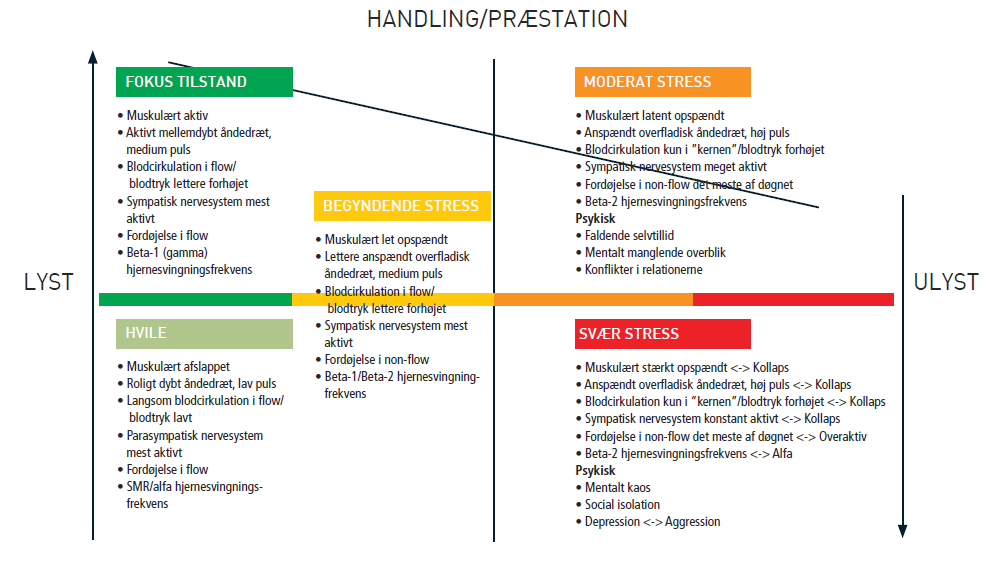
Stress can be viewed on a continuum from 'rest' to 'severe stress'.
Rest
When you are at rest, you will feel that your body is relaxed. The muscles become so relaxed that you sink into the "core" of yourself and the mind becomes almost empty of thoughts. You might feel a rush of lightness in your head and your senses are clear. You smell, taste, feel, and see shape, color, and texture. When your body and mind call for a break, you feel delighted to take a break and pleasure is a kind of natural background presence.
When it is time to sleep, you spend a few minutes slipping from activity into a light, floating state before drifting off into sleep, which usually lasts 7-9 hours. You either sleep all the way through or perhaps wake up once or twice to sniff the wakefulness before letting go again and drifting off to sleep.
Focus mode
When you are in focus mode, you experience being able to use your body for exactly the activity you want. You can flexibly switch between activity and rest, and you can get your brain to concentrate for a good amount of time when a task is in front of you.
Breathing is deep, wide, and circular, and you can effortlessly fill your lungs with oxygen and empty them of carbon dioxide. You are aware of your senses and you feel hunger and satiety. You use your hearing, and when you need to, you turn off your external listening and sink in and concentrate. You use your sight, active and focused, yet relaxed in the eyeballs and around the eyes.
You are aware of how food tastes when you eat: sour, sweet, salty, bitter, expanding, constricting. Your sense of smell is alive; you smell spring, fall, the freshness of laundry, a lovely perfume from a passerby. Your sense of touch is at ease. You are neither oversensitive to touch nor paralyzed in your ability to feel, and when a loved one hugs and strokes you, you feel it on your skin as a ripple of life.
Different emotions are allowed to shift in you during the course of the day. Joy, irritability, anger, neutrality. You laugh when something funny happens. You easily connect with the fact that there are people you love and care about. You feel meaning, coherence, and engagement in most of your life.
Incipient (optimal) stress
Stress is, in its essence, something quite positive, because it activates a potential in the body and mind. It is an inseparable part of life that occurs when people react to challenges, demands, and changes. Optimal stress is an adaptive reaction, where the body and mind try to adjust to the new situation. The autonomic nervous system is activated, there is an increase in blood pressure and heart rate, and the muscles receive an increased amount of blood. We become focused and concentrated.
Incipient stress can therefore be described as optimal stress because this is where we expand the limits of how much we can do or perform, or at least touch the red zone. When you taste optimal stress once or twice a day for an appropriate amount of time, you still have the free will to take a quality break. Optimal stress and a job well done should preferably be followed by a break of appropriate quality so that it does not develop into moderate stress, which in the long run is undesirable.
Moderate stress
Moderate stress, in clinical terms, is an unpleasant state of disequilibrium created by problems that you feel overwhelmed by, and where feelings of unmanageability, tension, and/or lack of control may be dominant.
We are constantly exposed to stimuli that can potentially be perceived as stressors. For some people in some situations, these may be perceived as positive stimuli, while for others they may be perceived as stressful conditions. In other words, it is a person's internal perception of an external (or internal) influence that determines whether they are stressed or not. It is thus the reaction of the nervous system that will reveal whether a person perceives something as a stimulus or a stressor.
Short-term stress is quite harmless, but long-term stress can be dangerous. Over time, a certain basic level of tension can creep up and settle in the muscle corset, and it will be there whether we are working, taking a break, or sleeping. When we experience a tendency to muscle soreness and maybe even a headache on a regular basis, it is a sign that the body has 'stuck' in too high a gear and cannot shift down again.
It is a poor utilization of energy because it is a bit like leaving a car in the driveway and constantly pressing the accelerator while it idles, without getting anywhere. It is just burning gasoline. When the gas tank is eventually emptied, exhaustion will follow and it can feel almost impossible to refuel as it disappears again in the same moment it has been added.
There will also be an imbalance in the nervous system, either with a constant activation of the sympathetic nervous system, which leads to constant anxiety and restlessness, or with a too constant activation of the parasympathetic nervous system, which leads to exhaustion.
Typically, too much cortisol is produced, which will activate the parasympathetic nervous system, because the body is trying to slow down, but without achieving the necessary relaxation. The body continues to secrete cortisol and the physiological reactions are reduced heart rate, low blood pressure, reduced blood flow to the muscles and increased activity in the intestines, often resulting in general indigestion.
here will be a reduced passage through the lungs, so the body is neither oxygenated nor cleansed adequately, and there will be reduced sweating and suppression of immunological activity, making the person more susceptible to viral infections. The emotional states that can follow are depression, sadness, hopelessness, helplessness, and abandonment. Desire, commitment, and physical and mental energy can no longer be activated, and the free will is on its way to being suspended. Now we can talk about stress in a clinical sense.
Severe stress
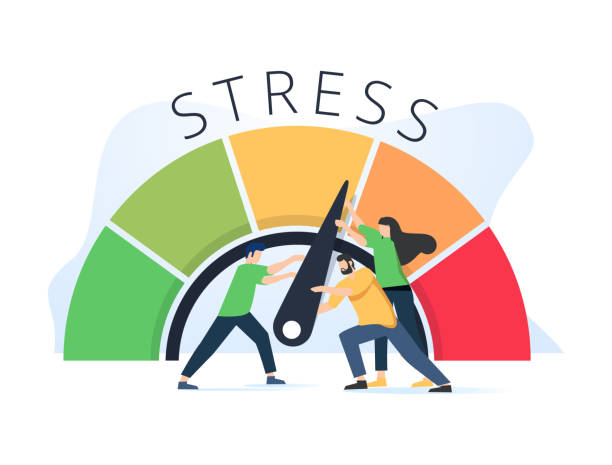
Severe stress occurs when the physiology has been out of balance for a prolonged period of time. The psychological consequences such as anxiety, depression, irritability, and even aggressiveness have become almost permanent. People become more and more isolated and find work and social interaction unmanageable.
Various infectious diseases can occur and flu-like symptoms will often appear when it is time for a vacation. Mental chaos and the accompanying inability to concentrate have become a permanent condition. It has become difficult not to use stimulants such as coffee, alcohol, sugar, and perhaps even various forms of self-medication to 'keep going' until one day you either physically and/or mentally collapse.
Free will is suspended, which is why it seems utterly foolish when a close family member or a well-meaning practitioner says: "Go home and relax". It is no longer possible to simply decide to relax. Isolation and being alone is on the one hand the only option when you cannot work or be 'on' socially, but at the same time, it is initially chaotic, deeply uncomfortable, restless, and tense. There is a constant rush of thoughts and insomnia has become a normal part of the condition. One no longer gets the vital rest needed to break the negative spiral.
If a person has become severely stressed, they need professional help to first navigate in the chaos and then navigate out of the chaos.

