
Stress and the body systems
Pain creates physiologically stressful conditions in the body. First and foremost, in the nervous system, and over time in the hormonal response to pain. Also, most people experience the body's muscular response to stress and pain fairly quickly. This is because you automatically tense up your muscles as they work together to get ready to act out of the condition (fight or flight) when you experience pain and stress.
However, when the pain is chronic and therefore also meaningless in terms of ensuring survival, it is not possible to fight or escape from the pain. Here it becomes necessary to learn a completely different strategy for dealing with pain and stress than the body's natural response.
You have already been introduced to this strategy, which is based on mindfulness and acceptance - so far through the body scan and a series of yoga exercises that invite calmness and pain relief. This week, we will expand the exercises to more specifically involve the breath and teach you how to use the breath to calm the nervous system through mindfulness exercises focusing on the breath.
Stress is a condition that affects the whole body system and therefore stress is reflected in all the interrelated systems of the body.
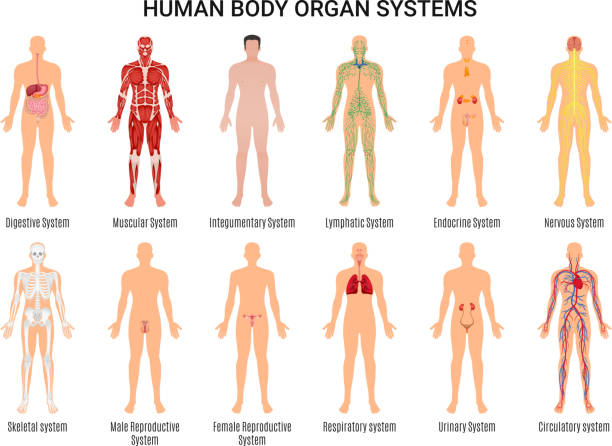
Nervous system
The nervous system is closely linked to the whole highly complex endocrinological (hormonal) system. Therefore, when the nervous system is activated due to stress, it also affects the hormonal balance in the body.
Skeleton
Have you had or do you have bone tenderness, stiffness, or injury? Soreness and stiffness in bones, and especially joints, are often signs that your health is not optimal.
Muscles
Latent muscle tension is often the consequence if we push ourselves without giving ourselves breaks. Or if we 'freeze' in certain sitting positions. Shoulders lifted up under the ears cause neck and upper back tension, which can manifest down to the lower back, buttocks, and anus which may be kept constantly tense. The phrase 'clenching the buttocks' is the concrete expression of pushing oneself, pulling oneself together. It can also spread to constant tension in the chest, diaphragm, and abdomen or persistent low back tension, where the muscles are unnecessarily (over)working.
Breathing
The result of persistent muscle tension might be that there is not enough room for breathing. Not only can muscle tension lead to an imperfect respiratory system, but also various emotional states and thoughts can "settle" in the respiratory system and lead to shallow and uneven breathing.
Heart and blood circulation
Stiff bones, tense muscles, and held breathing. Any or all of these affect the circulatory system. The heart and chest are where we often first feel our emotions. So even though it feels almost miraculous that the heart beats again and again, persistently and without breaks throughout life, the heart is highly susceptible to stress.
For now, just this (banal yet important) reminder:
You are a finely interconnected system.
Your body is your temple.
It is meant to last for many years.
If you experience recurring pain, then everyday things like sleeping well and deeply, being able to study, reading with concentration and focus, going to work, being social, exercising, etc. will gradually become increasingly difficult. Something that just "is", such as falling asleep, now becomes an impossible and resource-intensive project that might fail time and time again.
Resources, both physical and mental, are depleted - and gradually stress arises from the more psychological and social challenges that come from not being able to be 'normal'. Normal things that used to be part of one's life now become unmanageable projects.
Stress therefore often becomes a 'gateway' to more negative emotions. As stress is associated with 'danger' and acting or reacting, it can cause anxiety, which can lead to fear if one cannot act in an appropriate way.
After a long period of overexcitement, when stress levels are too high, there is exhaustion and perhaps abandonment and a feeling that there is no way out. This can lead to the development of sadness, exhaustion, and stress-related depression.
The process in which a chronic pain sufferer begins to recognize, for example, the loss of life opportunities caused by the chronic pain condition might trigger a grief reaction and a grieving process that alternates between "pure grief" and then depressive states that come and go. Occasionally, there is the strength to act to at least try something, but if you do not get positive effects from trying, you will experience stress and perhaps anxiety and a feeling that there is no way out of the "circle of pain". This in turn can lead to depression and perhaps grief.
When endometriosis is an underlying condition, there is a risk of alternating between stress and exhaustion, where the exhaustion may be dominated by more depressive feelings. The emotionally challenging states are thus seen as 'natural' consequences of being challenged physically, mentally, and socially as a result of the pain.

