
The link between body, thoughts, feelings, and behavior
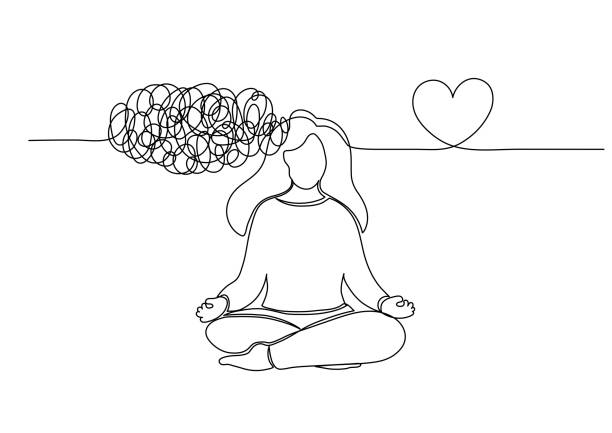
We are an interconnected system. This means that when you feel discomfort or pain from your body, for example, it can trigger negative thoughts, such as worry or even catastrophic thoughts, which in turn can trigger negative emotions, such as anxiety/fear, sadness or anger, which in turn can affect the way you react, your actions and perhaps result in you doing something that is essentially bad for you. You may resort to avoidance or even become paralyzed.
It's important to understand that your body, thoughts, feelings, and actions affect each other mutually, both in a negative and positive way. We can take advantage of this in the sense that if we can change something negative into something positive in just one of these places, it can have a positive impact on the whole system.
In mindfulness, we also work to slow down the impact that the different areas have on each other. This means that we work on how we can, for example, stop bodily pain and discomfort from causing negative thoughts, or negative thoughts from causing negative emotional states, which in turn can trigger muscle tension or shallow breathing in the body.
We do this by training ourselves to be more observant, accepting, non-judgmental and non-reactive.
The body
The body is a resource we often forget or take for granted, but it tells us exactly how we feel. Unfortunately, we are often too busy thinking instead of paying attention to the signals our body sends us.

We are trained to ignore the body in order to achieve our goals, but bodily sensations can provide valuable information when we want to get rid of an uncomfortable condition. By paying attention to our bodily sensations, we can avoid getting carried away by worries, thoughts from the past, or thoughts about the future, and we can become better at noticing what our body is actually telling us that we need right now.
For example, if you suffer from pain, you may experience a strong aversion to your body's signals. By ignoring the bodily sensations, you have, you won't notice what else your body is telling you, such as; you're stressed and need to slow down, that you're sad, or that there's exhaustion, tension, or fatigue that needs to be respected in order to not use more resources than you have.
Occasionally, when something important needs to be done, it may be necessary to ignore the pain for a short time, i.e., put it in the background, but this should never be consistent or automatic. By sensing the body directly without evaluating, judging, or reacting mentally and emotionally to what we experience, we are able to register and act sensibly on the body's messages. We don't want to live life through our heads and the inner commentary that thoughts can take the form of. In this way, we can both deal with the negative automatic thoughts that keep popping up in our heads and the unpleasant emotions they trigger, and we can adjust the body so that it can thrive better, even if there is still pain.
Thoughts, emotions, and bodily sensations are interrelated and can influence each other. This happens both unconsciously and constantly, and we can use this connection to do more good things for ourselves.
Thoughts
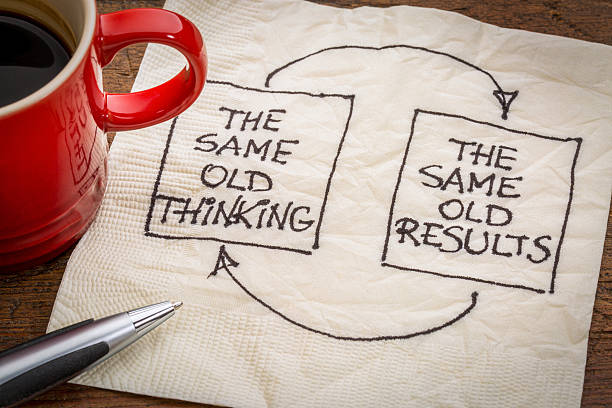
As human beings, we have the ability to think about things, which enables us to solve problems on a mental level before acting. However, this ability can become problematic to the point where we confuse our thoughts with reality itself. This is because thoughts are just mental constructs. They are imaginations, interpretations, and judgments, but not necessarily truths or facts. Thoughts come and go. We are not our thoughts, we have thoughts.
If you suffer from pain, negative thoughts about your bodily sensations can trigger unpleasant feelings, which in turn can intensify the pain. Therefore, it may be necessary, for example through mindfulness training, to develop a new and different relationship with your thoughts, where you simply let them be instead of being consumed by them, analyze, or try to get rid of them.
Through mindfulness training, we can practice seeing thoughts as mental constructs that come and go like clouds in the sky without having to take them literally. Instead, we can put thoughts aside and experience the world more directly by turning off our autopilot and just being present in the present moment.
Emotions

Our emotions depend among other things on our thoughts. We are constantly explaining, interpreting, analyzing, and evaluating ourselves and the world around us in our thoughts. We react emotionally to the content of our thoughts and not necessarily to reality as it is. Therefore, our thoughts have a huge impact on how we feel emotionally, and our emotions will in turn be expressed through our bodily sensations.
There is a change in our emotions when there is a change in our thoughts – that is, a change in our interpretation of ourselves and the world around us. Just like thoughts, emotions are not truths. They are snapshots. Emotions come and go as a consequence of changes in our perspective, and we can learn how to avoid being consumed and overwhelmed by them, and how to avoid identifying with them and letting them control us.
Actions - "being" or "doing"
In everyday life, we take action to achieve our goals. We use analytical thinking to solve our problems by, among other things, calculating the distance to the goal and planning how to get there. But when it comes to emotions, i.e., dealing with or "getting rid of" unpleasant feelings, analytical problem-solving works very poorly. Constantly focusing on the gap between how we currently feel and how we want to feel (or how we think we should feel) will often leave us in an even worse mood.
An alternative strategy for dealing with unpleasant feelings is to be present and observe the feelings without judging or evaluating them and without trying to change them. When we practice mindfulness, we practice changing our orientation from acting to just being. We train our attention and turn off the automatic pilot.

When you practice being instead of doing, it will also be a tool for breaking the negative reaction pattern between bodily sensations, negative thoughts, unpleasant emotions, and behaviors. It is training to become "non-reactive" to the bodily sensations that are present, the negative thoughts that arise, and the subsequent unpleasant feelings.

