
How does the pain experience start?
To understand how a sensory input (a peripheral stimulus) becomes a pain experience, it's important to know a little bit about the nervous system.
Pain used to be understood as a one-way process that ran from the injury through the nervous system and up to the brain. It was believed that the peripheral stimulus, also known as a nociceptive input (for example, a burn on the skin), was sent as information from the peripheral nervous system to the brain. It was believed that the experience of pain in the brain would occur in a direct 1:1 relationship, meaning that the experience and intensity of the pain would be directly proportional to the severity and degree of the burn. This understanding of pain stemmed from dualism, where the body and mind were perceived as completely separate phenomena that could not affect each other.
However, today we know that the experience of pain is much more complicated than this. The experience of pain does not come from the brain just "blindly" interpreting the nociceptive input from the peripheral nervous system in a 1:1 ratio. Instead, the experience of pain takes place in a feedback loop from the nociceptive input via the nervous system to the brain and back again in a constant and complex interactive process. A process in which psychological factors linked to different areas of the brain also influence the experience of pain.
In the following, we will try to explain in a simplified way how a nociceptive input can end up as a pain experience in a healthy and well-functioning pain system.
Pain perception and pain modulation
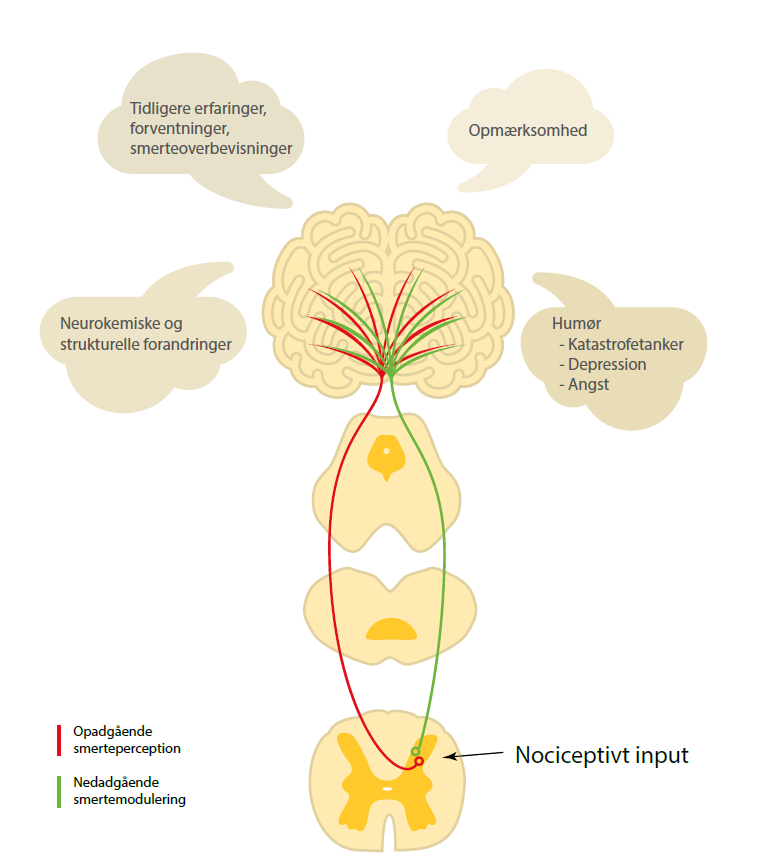
As you can see from the image above, the experience of pain, also known as pain perception, starts with a nociceptive input running from the peripheral nervous system, through the spine and up to different areas of the brain. In these areas, it then undergoes various changes, also known as pain modulation.
These changes happen as automatic reflexes but can also be triggered by various psychological factors including thoughts, emotions, past experiences, or expectations.
Depending on the quality of the psychological factors (whether they are more negative (e.g., depression, anxiety, or catastrophizing) or more positive (joy, curiosity, and positive expectations)), the psychological factors can either increase or inhibit pain perception, meaning that the strength of the pain experience will be either increased or decreased.
This is also where psychological treatments are thought to be able to change the experience of pain, namely by changing the quality of the psychological factors (e.g., by reducing stress, depression, anxiety, and catastrophizing and optimizing feelings of pleasure and positive expectations).
This is one of the reasons why we will be dealing with several of these topics (stress, anxiety, depression, etc.) over the coming weeks, partly because they influence the experience of pain, but also because stress, anxiety, worry, depression, and sadness are themselves frequent side effects of painful endometriosis.

