
Pain and suffering
The negative impact and consequences caused by the physical pain experience are called suffering. It is not only the pain itself but also the way you react to the pain mentally, emotionally, and behaviorally that can exacerbate the pain problem and the negative impact on everyday life.
The reaction to pain can be conscious, but often it is a completely unconscious reaction that, if you become aware of it, can be changed to be more constructive rather than destructive. Examples of this are the insults that pop up in your mind or the anxiety, anger, sadness, or insecurity you may feel when you are in pain.
You may start avoiding certain things altogether in an attempt to avoid the suffering, the thoughts, or sadness and anxiety. Unfortunately, such "avoidance behavior" can result in a rather limited life, where attempts to control the pain and avoid the suffering cause major decisions to be made based on avoidance rather than what actually feels important and valuable to you.
Traditional pain management often focuses rather unilaterally on reducing what we might call purely physical pain, but it is also possible to do something to reduce the suffering caused by the physical pain. Less suffering can help make the overall pain experience less unpleasant.
The overall pain experience
Roughly speaking, the overall experience of pain can be understood as a complex interaction between bodily sensations, thoughts, feelings, and behaviors.
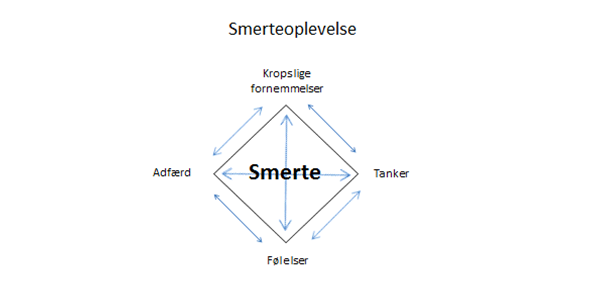
The bodily sensation of the pain experience could be the stinging, burning, hunting, or throbbing that you sense from the area of the body where the pain is located. The bodily sensation is often where the pain experience begins, and can trigger thoughts about the experience.
The thoughts associated with an unpleasant pain experience often consist of so-called catastrophic or negative thoughts. They may on the other hand trigger feelings of discomfort, anger, depression, sadness, frustration, shame, or guilt while the subsequent pain behavior may be characterized by avoidance, passivity, or attempts to control the pain in order to avoid the discomfort, the negative thoughts, feelings, and suffering.
Since bodily sensations, thoughts, feelings, and behaviors mutually influence each other, it is possible to change the pain experience by working to change just one or more of these aspects.
When it comes to chronic pain, it is often hardest to affect the pure physical pain, but this is usually where all the energy is put. In psychology, pain is therefore treated within a bio-psycho-social framework. This means that the treatment focuses on both physiological, psychological, and social aspects of the pain experience and the life with chronic pain.
When the physiological aspects of the pain can no longer be addressed, one of the most important methods of psychology is to shift the focus to the psychological or social aspects and consequences of the pain, where changes are still possible. Learning to live with pain can be a huge challenge for several reasons:
The body
It is natural to tense up your body when you experience pain, and this can cause fatigue and exhaustion in your body and mind. It can become a vicious cycle of pain, interfering with sleep and reducing concentration and energy throughout the day.
With yoga and mindfulness exercises, among other things, we train how you can learn to do something fundamentally unnatural in relation to the pain, namely, to relax. From next week, we will also train you to consciously use your breath to replenish your energy, and you will learn to control your nervous system in a way that "normal" people cannot.
The mind
It is a natural consequence of pain that thoughts and emotions become more negative. Feelings of hopelessness and helplessness can be the consequence of being locked up in a prison of pain. You may worry about whether close relationships will last... Whether you can maintain or return to work or education... You may worry about the disease progressing further... Have trouble concentrating, poor sleep... Identity issues... You may wonder what to do with your life if it continues like this...
Pain can cause stress, anxiety, depression-like thoughts, and feelings, or grief over having been affected by the disease. As part of this program, you will therefore also work with these feelings through various mindfulness exercises, making it easier to manage and let go of both worrying thoughts and difficult emotions and allowing room for joy and faith to grow in the future.
Relationships
As pain increases, our field of attention naturally narrows, and we become more introverted - and are perceived as more closed off by those around us. This means that your social life can be severely affected - perhaps even leading to a reduction in your social network and a feeling of abandonment.
Connections to education and work are also threatened, which can affect finances, identity, dreams, and goals in life. We will therefore also work with values - that is, what is important to you, whom you want to be, and where you want to go with your life, so that overall you will end up more clarified and satisfied in relation to both work and your private life, with any partner, friends, and family.

